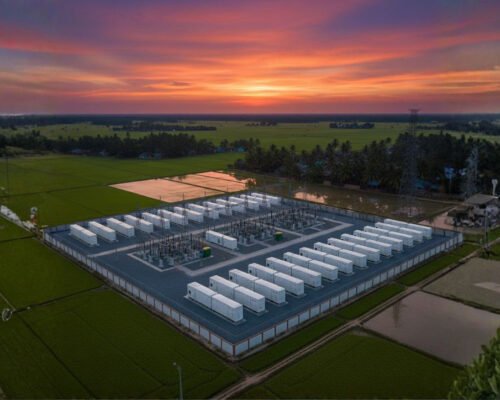

Renewables in Bangladesh
Battery energy storage systems improve power reliability and optimize renewable energy use in Bangladesh’s evolving power sector.
BESS
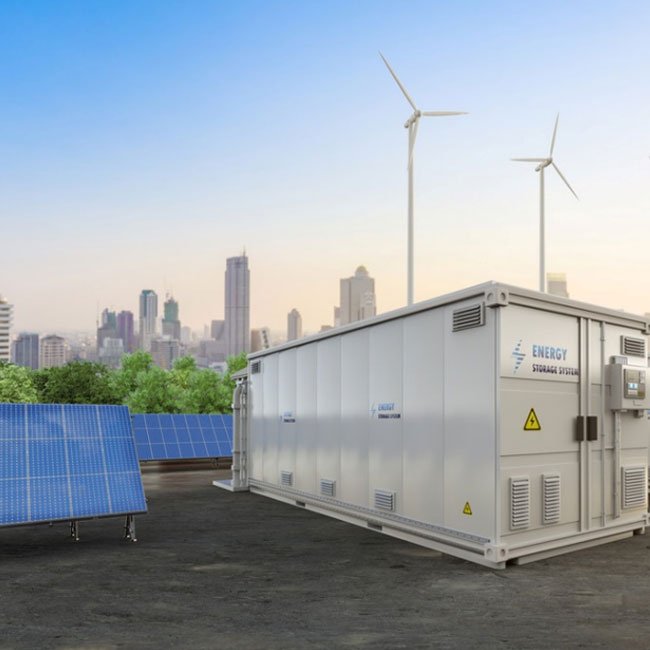
A battery energy storage system (BESS) is a technology that stores electrical energy in rechargeable batteries for later use, acting like a large-scale rechargeable battery. It captures surplus electricity, often from renewable sources like solar and wind, and discharges it during peak demand or when renewable generation is low. A BESS consists of a complex, integrated system that includes the batteries themselves, power conversion systems (PCS), and sophisticated controls to ensure safe and efficient energy storage and delivery.
How BESS Systems Works
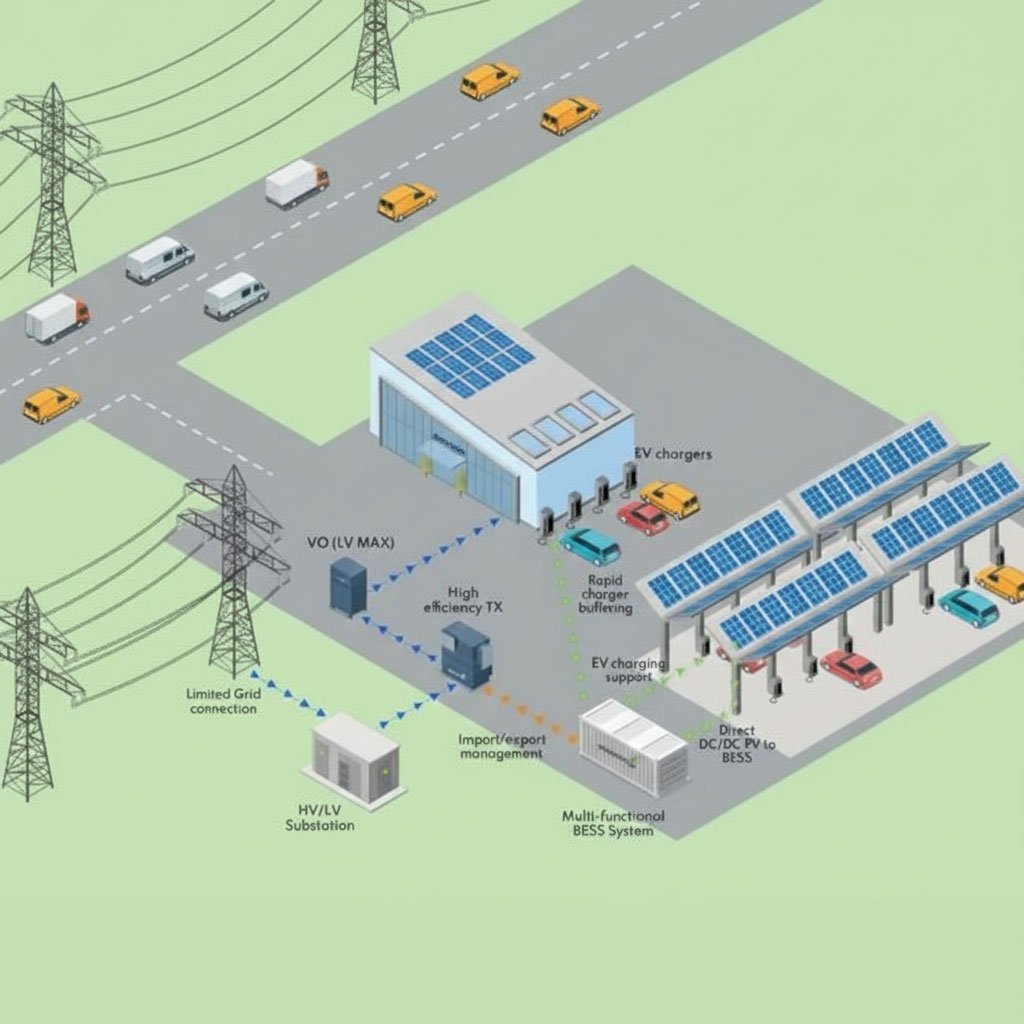
A Battery Energy Storage System (BESS) operates by capturing and storing electricity in large battery banks when energy supply exceeds demand, such as during midday solar generation or low-demand grid hours. The system is built from multiple layers of battery cells assembled into modules, racks, and full battery strings to achieve the required capacity.
The stored energy, which is in DC form, is managed by a Power Conversion System (PCS) that converts DC to AC for grid or facility use, and AC to DC during charging. At the heart of the system is an intelligent Energy Management System (EMS) and Battery Management System (BMS) that monitor voltage, temperature, state of charge, safety conditions, and grid signals to optimize battery lifespan and operational efficiency.
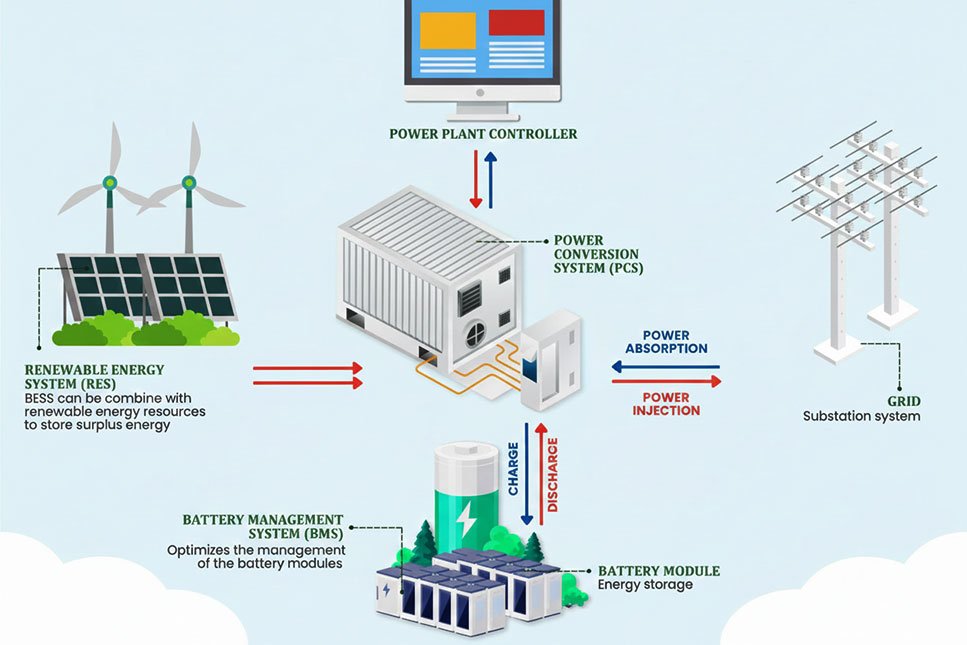
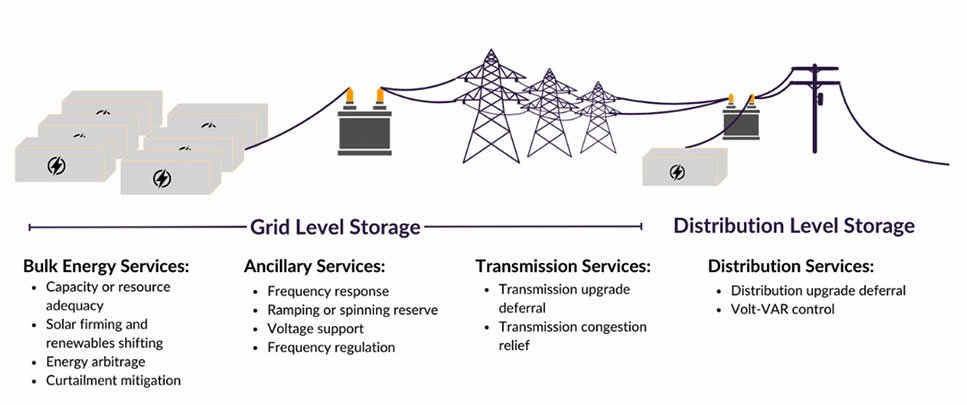
In addition to delivering energy during peak hours, BESS supports the grid through frequency regulation, voltage stabilization, peak shaving, load shifting, and backup power. The system is complemented by critical ancillary components such as cooling systems, fire suppression units, transformers, circuit breakers, switchgear, and protection devices to ensure safe and reliable long-term operation.
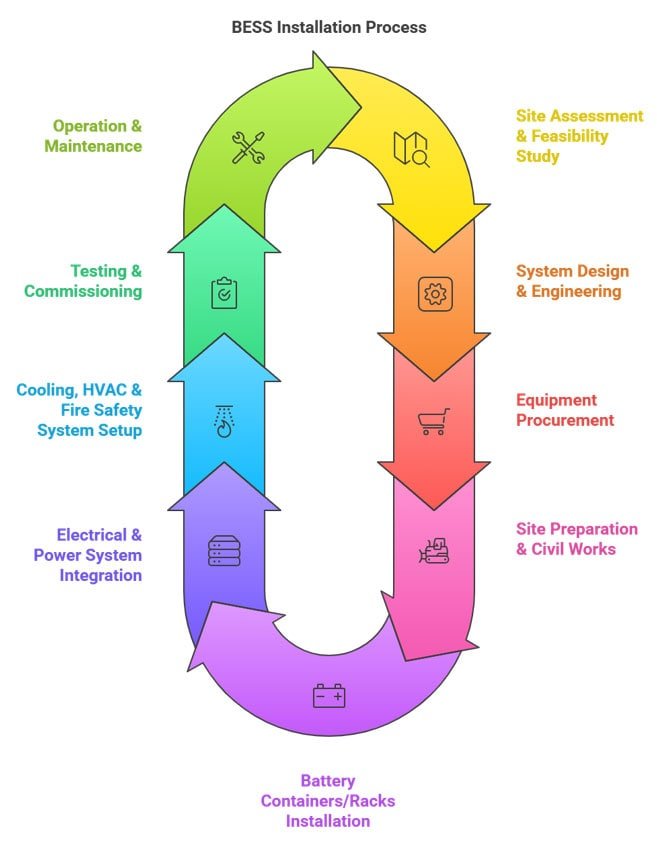
Installation Process of a BESS System
- Site Assessment & Feasibility Study
- Evaluate available space, grid connection point, load profile, and safety requirements.
- Assess environmental conditions (temperature, humidity, flooding risk).
- Conduct a grid impact study and determine the required interconnection capacity.
- System Design & Engineering
- Select battery technology (typically Lithium-ion).
- Determine system capacity (kWh/MWh) and power rating (kW/MW).
- Design layout for battery containers, PCS/inverters, transformers, and switchgear.
- Integrate EMS (Energy Management System) and BMS (Battery Management System) specifications.
- Procurement of Equipment
- Battery containers or racks
- Power Conversion System (PCS) / bi-directional inverter
- Transformers and switchgear
- HVAC/cooling units
- Fire detection and suppression system
- EMS, BMS, sensors, and protection devices
- Site Preparation & Civil Works
- Prepare foundations/concrete pads for battery containers and electrical equipment.
- Install cable trenches, grounding rods, and fencing for safety.
- Provide environmental control measures (drainage, shading, ventilation).
- Installation of Battery Containers/Racks
- Place battery racks or modular containers on foundations.
- Connect modules into racks and racks into full battery strings.
- Install BMS sensors, wiring, and communication interfaces.
- Electrical & Power System Integration
- Install PCS/inverters and connect DC cables from battery racks.
- Connect PCS to transformers and AC switchgear for grid or facility tie-in.
- Install protection devices: circuit breakers, relays, SPDs, and isolation switches.
- Integrate SCADA/EMS for real-time monitoring and control.
- Cooling, HVAC & Fire Safety System Setup
- Install HVAC units to maintain battery temperature range.
- Set up fire detection and suppression systems (e.g., aerosol, gas-based systems).
- Implement ventilation and exhaust systems for thermal and chemical safety.
- Testing, Commissioning & Validation
- Perform pre-commissioning electrical checks.
- Test PCS operation, communication links, and BMS/EMS functionality.
- Run charge-discharge cycles to verify performance.
- Conduct safety, insulation, grounding, and fire system tests.
- Complete grid interconnection testing as required by the utility.
- Operation, Monitoring & Maintenance
- Continuous monitoring through EMS/SCADA for performance and health.
- Routine inspections of battery health, temperature, and connections.
- Scheduled maintenance for HVAC, PCS, transformers, and protection systems.
- Periodic safety drills and system updates for cybersecurity and software.
In addition to delivering energy during peak hours, BESS supports the grid through frequency regulation, voltage stabilization, peak shaving, load shifting, and backup power. The system is complemented by critical ancillary components such as cooling systems, fire suppression units, transformers, circuit breakers, switchgear, and protection devices to ensure safe and reliable long-term operation.
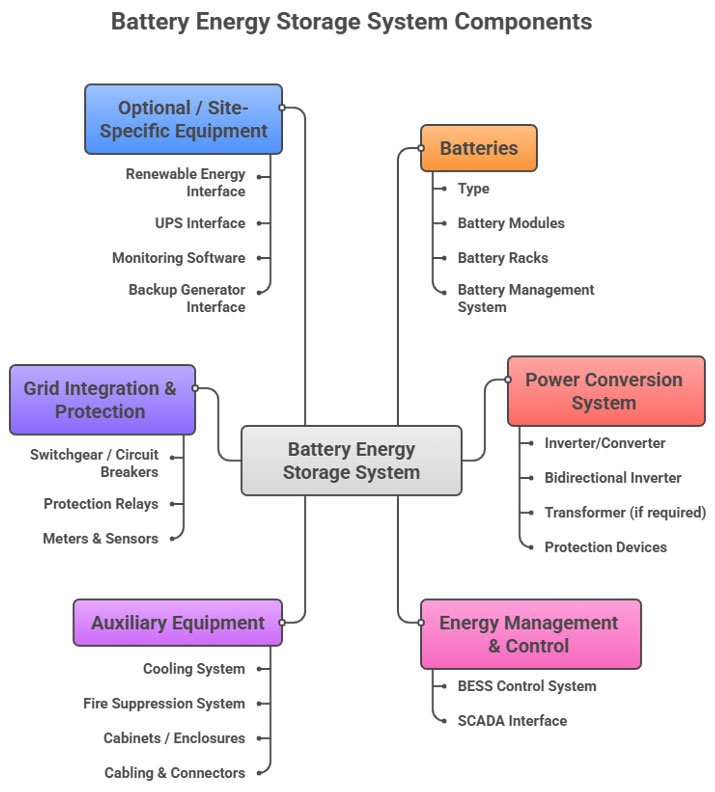
Equipment List for a BESS System
- BATTERIES
- Type: Lithium-ion (Li-ion), Lead-acid, Flow batteries, or other chemistries depending on application.
- Battery Modules: Individual cells or pre-assembled modules.
- Battery Racks: Structures to mount and secure battery modules.
- Battery Management System (BMS): Monitors cell voltage, temperature, state-of-charge (SoC), and ensures safe operation.
POWER CONVERSION SYSTEM (PCS)
- Inverter/Converter: Converts DC from batteries to AC for the grid or loads and vice versa for charging.
- Bidirectional Inverter: Enables both charging and discharging.
- Transformer (if required): Steps up/down voltage for grid connection.
- Protection Devices: Circuit breakers, fuses, disconnect switches.
ENERGY MANAGEMENT & CONTROL
- BESS Control System / EMS (Energy Management System):
- Monitors battery performance.
- Optimizes charge/discharge scheduling.
- Provides communication with the grid operator or local load controller.
- SCADA Interface / HMI: Allows real-time monitoring and operation.
AUXILIARY EQUIPMENT
- Cooling / Thermal Management System: Air or liquid cooling to maintain optimal battery temperature.
- Fire Suppression System: Fire detection and suppression (e.g., clean agent systems for Li-ion).
- Cabinets / Enclosures: Weatherproof and secure housing for batteries and electronics.
- Cabling & Connectors: DC and AC cabling, busbars, junction boxes.
GRID INTEGRATION & PROTECTION
- Switchgear / Circuit Breakers: For isolation and protection.
- Protection Relays: Overcurrent, overvoltage, undervoltage, and anti-islanding protection.
- Meters & Sensors: Voltage, current, temperature, and SOC sensors.
OPTIONAL / SITE-SPECIFIC EQUIPMENT
- Renewable Energy Interface: Solar PV or wind integration.
- Uninterruptible Power Supply (UPS) interface: For critical load backup.
- Monitoring Software & Cloud Platform: Remote monitoring, analytics, and predictive maintenance.
- Backup Generator Interface: For hybrid systems.
Investment for BESS Systems Installation
The investment needed for BESS installation in Bangladesh is significant and varies based on project scale, with a 10 MWh system potentially costing $2.5 to $5 million. This cost includes site preparation, batteries, inverters, and grid integration. The government is actively promoting investment through incentives and partnerships with development organizations, which are also providing funding for pilot projects, as well as through initiatives like private sector participation under build-own-operate models to reduce capital outlay for the government.